The State of AI for Vertical Market Operators

BENCHMARK REPORT

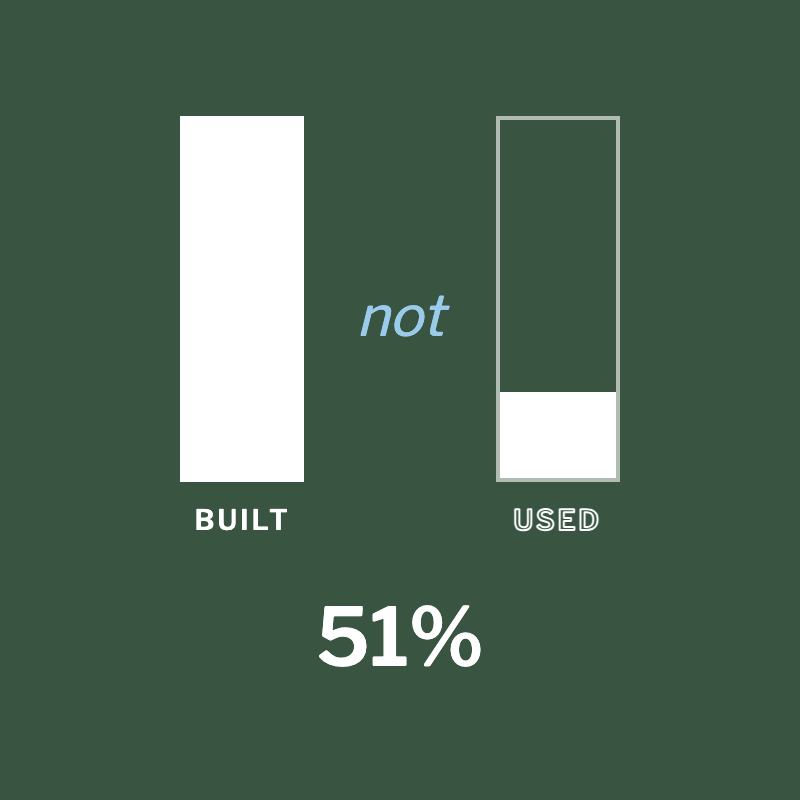
Half of software companies are shipping AI features their customers don't use

We surveyed 260+ VMS founders, CEOs, and operators on what they’re actually doing with AI. Here’s what they told us.

Every operator has an AI opinion. Almost none had the data. So we asked.

The State of AI for Vertical Market Software Operators is our first benchmark report, built from honest answers from more than 260 founders, CEOs, and operators of vertical market software companies. What it reveals is an industry-wide gap: AI development has taken off, but customer adoption is lagging.

The operators who rushed to adopt AI without a clear strategy often ended up with tools employees and customers never use. Those who moved sooner than they felt comfortable, but watched closely to understand what was working, pulled ahead regardless of age, experience, or funding.

Six things your peers told us

  • 51% of software operators see fewer than one in four customers actually use the AI they built. Deployment, not development, is the industry’s biggest AI challenge.
  • 44% said their biggest regret was not starting sooner. But speed alone isn’t the differentiator. The operators pulling ahead moved fast and measured what worked.
  • Funding doesn’t matter as much as you’d think. Bootstrapped companies and PE-backed companies are equally likely to progress (32% vs 33%). Execution rigor is the differentiator.
  • AI leaders see four times the revenue impact (45% vs 9%).
  • AI leaders are nearly 20 times more likely to report retention improvements (37% vs 2%).
  • The winners aren’t drowning in tools. The most successful operators pick one or two platforms, assign a clear owner, measure customer activation, and build AI into customer workflows rather than keeping it internal.

“The environment around AI has created immense pressure for software operators to evolve faster,” says Max Risen, President of M&A at Banyan Software. “Our findings challenge this notion. It’s not simply about more lines of code. It is about organizational rearchitecture, leveraging valuable distribution networks, and harnessing frontier technology with intention and evaluation to ensure that customers end up with solutions that drive business outcomes.”

The view from an operator

“Our clients care about onboarding their subscribers, keeping them happy, while maintaining cost discipline,” says Sean Biganski, CEO of BeQuick, a Banyan portfolio company. “When they do ask about AI, it’s in that same framing: can it help launch a product faster, get the business rules right, sign someone up without friction? AI is why we can now build for that in ways that were once out of reach. That moves the bottleneck off engineering and onto the harder question: not what we can ship, but what customers will actually use, and who in the organization has the judgment to make that call.”

Read the full report

The full findings, including the AI maturity framework and what separates AI Leaders from the field, are available now.

Read The State of AI for VMS Operators →

Methodology: Banyan Software surveyed more than 260 founders, CEOs, and operators of vertical market software companies. AI maturity was measured across three dimensions: level of AI deployment, tracking of customer adoption, and measurement of business impact. Operators scoring above a threshold were classified as AI Leaders and compared against the field on revenue impact, retention, and growth.

Related content

GUIDE

How to guide: Finding the right fit

This 3-stage guide is designed for business owners considering a sale, now or in the future.

VIDEO

Seller Story: Paul Nixon

Paul Nixon, co-founder and CEO of Intuitive, reflects on navigating the sale process, highlighting efficient due diligence and the importance of finding the right partner.

author avatar
Deanne Reimer

Start typing and press Enter to search

Shopping Cart